small-model-skills
A natural-language front-end to your own machine — local, offline, and fast enough to mean it.
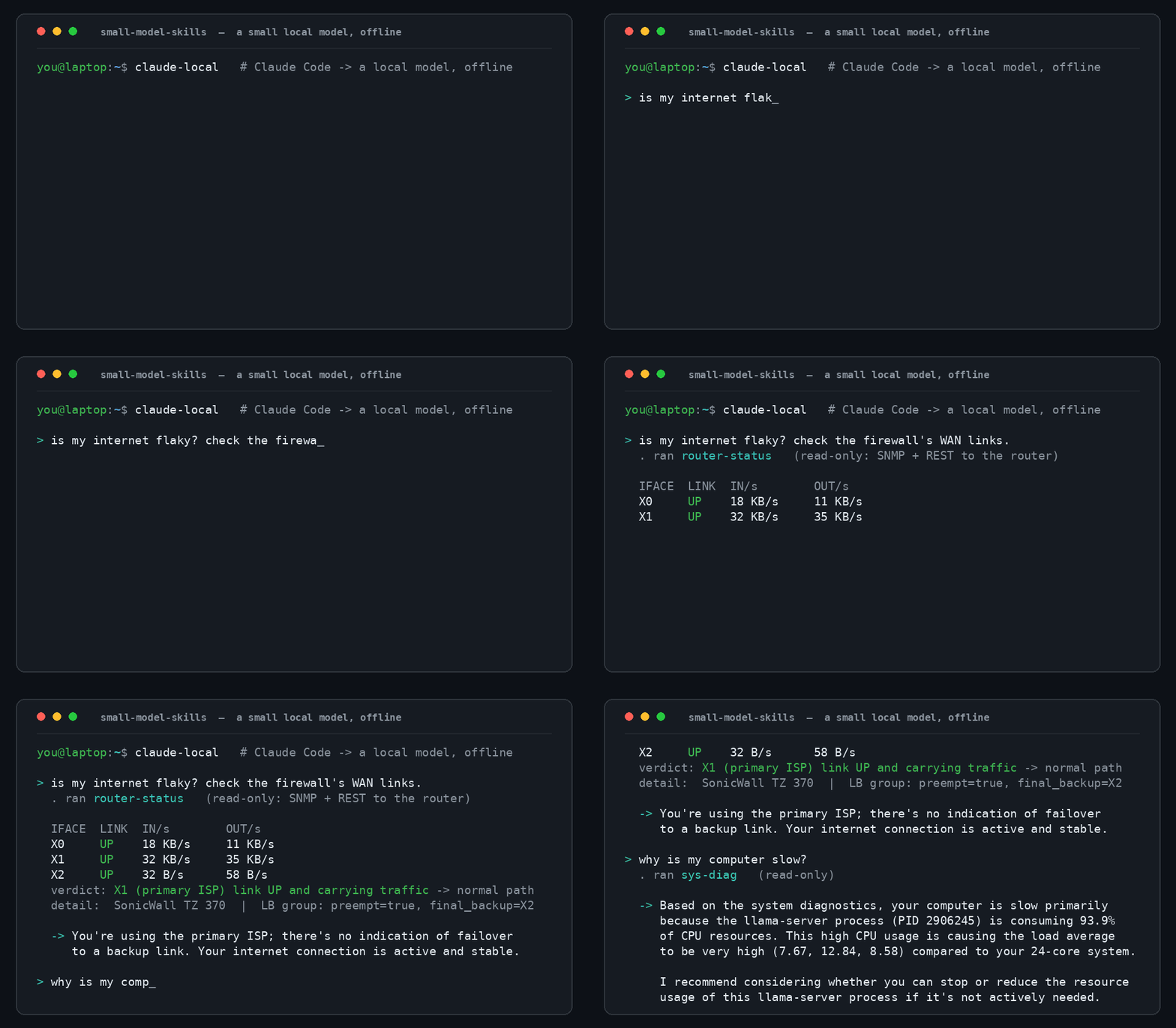
You run a small model on your own hardware — a plane, an outage, an air-gapped box, or just to keep the endless small ops questions off a metered API. small-model-skills makes that model genuinely useful: ask "why is my computer slow?" or "is my internet actually down?" in plain English, and it runs a read-only diagnostic and tells you — in seconds, proposing fixes, never running them. It's a library of Claude Code Agent Skills, each backed by a deterministic shell tool that does the real work and hands the model a verdict to explain.
Why this works now — and didn't a year ago
I was skeptical of my own project. If you already know the command, typing it is faster and more reliable than asking a model to run it. For a long time that skepticism was correct. Then three things crossed a line at once, and I have the benchmarks — on a 12 GB consumer GPU — to show it:
- A small MoE model is fast enough to mean it. A Mixture-of-Experts model carries a big brain but only
fires a few billion parameters per token. On my 12 GB card, a ~30B MoE coder (
qwen3-coder) ran at ~40 tokens/sec; a dense 49B managed 2.7. That's ~15×. It turns a five-minute answer into a few-second one — the difference between "slower than typing" and "just ask it." - A coder model handles the tool-loop. Reason → run the tool → read → decide. Modern ~30B coder models do this reliably — the floor the tiny 7B models never had; it stops the model from hallucinating a problem that isn't there.
- It's free and local. No API meter, no network. Which means it can run unattended — background jobs that watch, diagnose, and propose fixes — something you'd never do on a per-call bill.
Put together: a local model that's fast enough to beat typing and reliable enough to trust. That's the bet, and it's the small-end version of the bet I make everywhere — that structure beats willpower. The model is the weak part, so the structure carries the work: a deterministic tool gathers the facts and computes the verdict; the model just orchestrates and explains.
What it does
A dozen read-only skills for what actually breaks when you're on your own: why the machine is slow, why the disk is full, what service is down, whether the local model itself is loaded and fits in VRAM, why it froze, what Docker is eating — plus "prep this project before I lose signal" and "diagnose why the build fails offline." Everything is propose-don't-apply: the tools diagnose and suggest the fix; a human runs it. A weak model never touches your system.
Honest about the rest
The technique isn't mine, and I say so plainly — deterministic scaffolding with the model reserved for judgment is Anthropic's own guidance and Hugging Face's smolagents. What's mine is the curation and the target: a skill library built from the constraint down, for the model you're stuck with offline, with an authoring standard for skills a small model can actually execute. And it won't turn a 7B into a 70B — it raises the floor on what a small model does reliably. Think limp-home mode with a good engine, not a supercar. It's the small end of the spectrum, on purpose, and now it's fast enough to be worth it.
The same trick, online
The bet was always "structure carries the model." Offline that means a 30B model on a 12 GB card can do real work. It scales the other way too: the same scaffolding, pointed at a cheap cloud model, makes it punch at a frontier model's weight for structured jobs.
I measured it. A blind, rubric-scored benchmark (judged by Gemini 2.5 Pro, which didn't know which model was which) put GLM-5.2 at 34/36 against my local qwen3-coder at ~26 — and the gap is exactly where you'd expect, tool selection and restraint, not raw reasoning. So these same skills now review my code: a local gate runs GLM-5.2 on every pull request at about three cents a review, Opus-competitive on the hard cases. Limp-home mode offline; a $0.03 scalpel online.
MIT-licensed · built in the open · the small-end sibling of MetaObjects.